
By Gaurav Tekriwal
AI is creating new possibilities for personalised Vedic Maths practice by adapting questions, tracking progress, and supporting targeted learning with teacher guidance.
The Problem With Giving Everyone the Same Questions
Imagine a classroom with twenty students. One student is still building confidence with basic calculations. Another has already mastered the same level and wants more challenging problems. Yet both receive an identical worksheet. This is one of the areas where personalised learning can make a difference.
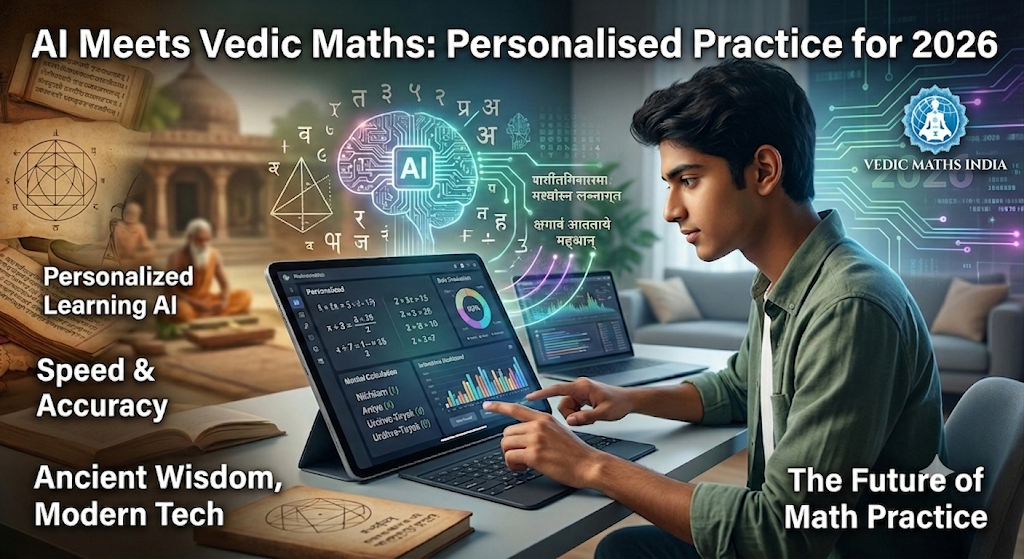
In 2026, Vedic Mathematics is entering a new phase where traditional calculation practice is increasingly being combined with digital technology and artificial intelligence. Vedic Maths Forum India has introduced an AI-powered practice engine designed to personalise questions according to individual learner performance.
From Worksheet to Learning Profile
A traditional worksheet mainly tells a teacher whether an answer is right or wrong. An adaptive system can collect a wider picture.
It can potentially examine:
- Which questions take longer
- Where mistakes occur repeatedly
- Which difficulty levels feel comfortable
- How performance changes over time
- Which areas need additional practice
This creates something closer to a learning profile. For Vedic maths learning, that can change how practice is planned. Instead of asking every student to complete another identical set, practice can be directed towards the areas where the learner actually needs more work.
What Does This Mean for “Vedic Maths What Is It”?
The question “vedic maths what is it” has traditionally been answered through techniques, Sutras, mental calculation and numerical patterns.
The 2026 learning conversation adds another question:
- How should those techniques be practised?
That distinction matters. The subject itself does not become “AI mathematics”. Rather, technology becomes another environment through which students can practise selected Vedic Mathematics methods. The human learning objective remains mathematical understanding.
AI Can Practise. Teachers Can Interpret.
This is where the role of the Vedic math teacher becomes especially important. Suppose a student repeatedly makes the same type of mistake. An AI system may identify the pattern. But the teacher can investigate the reason.
- The learner misunderstood the underlying idea.
- Perhaps the student is rushing.
- The explanation needs to be presented differently.
That human interpretation cannot simply be replaced by a score on a dashboard. Current research around AI-supported mathematics education also continues to emphasise the importance of teacher involvement rather than treating automated personalisation as a complete replacement for instruction.
A New Model for Online Learning
The idea also changes how a vedic math virtual classroom can operate.
Instead of:
Class → Homework → Next Class
the learning cycle can become:
Instruction → Individual Practice → Performance Review → Targeted Support → New Challenge
This model can be useful because students do not necessarily progress at identical speeds. One learner may need repetition. Another may need an application. A third may be ready for greater complexity. Technology can help organise these differences while the teacher remains responsible for instruction and judgement.
Where Competitive Preparation Enters?
The same principle can be useful for learners exploring vedic maths for bank exams. Competitive candidates often have limited preparation time. Instead of spending equal time on every numerical topic, targeted practice can help learners concentrate on areas where they need improvement. However, adaptive practice should remain part of a wider preparation plan.
Bank-exam aspirants still need:
Concepts + accuracy + question selection + timed practice + mock tests
AI can help organise practice. It cannot take the examination for the learner.
The Competition Angle Is Changing Too
For students considering a vedic maths competition 2026, digital practice offers another way to prepare. A learner can practise under different levels of difficulty and monitor personal progress before entering a competitive environment. But competition preparation should not become a race to memorise more techniques. Students also need concentration, accuracy and the ability to handle unfamiliar calculations.
What Parents Should Ask Before Choosing a Programme?
If you are searching for a vedic maths tutor near me, don’t ask only:
“How fast will my child calculate?”
Ask:
- Is practice adjusted to the child’s level?
- Does the teacher review mistakes?
- Is independent problem-solving encouraged?
- Is progress monitored?
- Are online tools used meaningfully?
- Can the student explain the method?
These questions can reveal much more about the quality of a learning programme.
The Bigger Opportunity for Vedic Maths
The concept of Vedic Mathematics is rooted in alternative approaches to mathematical calculation. Technology does not need to replace that foundation. It can change the way students practise it. The combination of structured instruction, personalised digital practice and teacher feedback creates a different possibility for modern mathematics education.
For Vedic Maths Forum India, this direction also connects its established work in Vedic Mathematics education with newer digital learning initiatives. The organisation was founded by Gaurav Tekriwal and has worked across student learning, teacher training and educational programmes.
Frequently Asked Questions
- Can AI replace a Vedic math teacher?
No. AI can support practice and identify performance patterns, while teachers provide explanation, judgement and personal guidance.
- How can AI personalise Vedic Maths?
It can use learner performance to generate or recommend practice at an appropriate level and provide feedback.
- Is AI suitable for beginners?
Yes, when it is combined with proper teaching and age-appropriate practice.
- Can AI help students prepare for bank exams?
It can support targeted calculation practice, but complete exam preparation requires concepts, mock tests and broader quantitative practice.
- Is online Vedic Maths learning becoming more personalised?
Yes. Adaptive digital learning is becoming a stronger part of mathematics education, although its effectiveness depends on how well it works alongside human teaching.
The 2026 Direction
The future is unlikely to be about choosing AI or teachers.
A more useful model is:
- AI for practice.
- Teachers for understanding.
- Students for thinking.
That combination gives Vedic maths learning a fresh direction. For parents, students and competitive-exam learners, the important question is no longer simply whether a programme offers more questions.
The better question is:
“Are the questions helping this particular learner improve?”
That is where personalised learning can make Vedic Mathematics more relevant to the needs of the 2026 learner.