
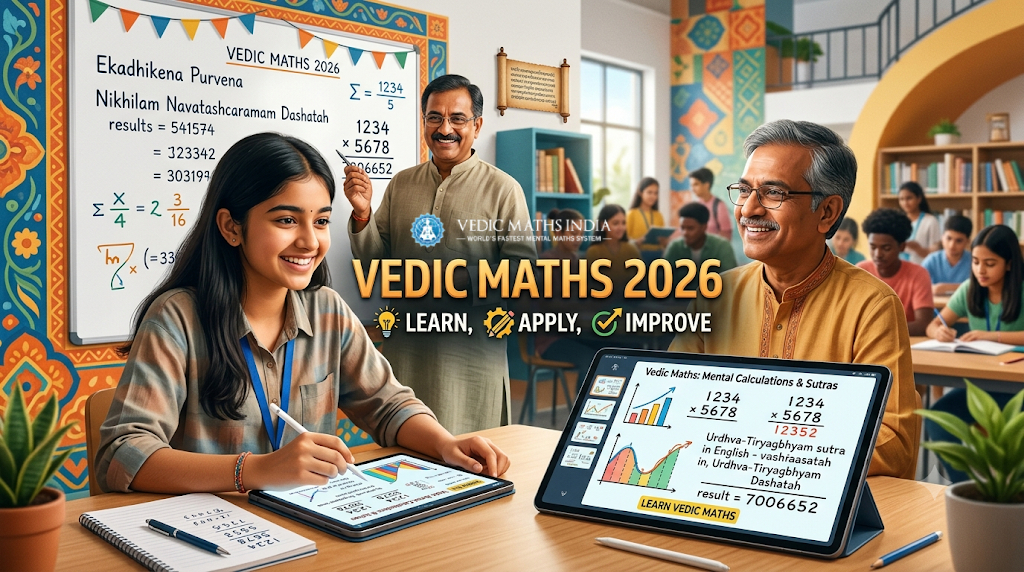
By Gaurav Tekriwal
Explore a practical Vedic Maths learning journey for students, teachers, competitions, and bank exams through structured practice and guided instruction.
A New Way to Look at Mathematical Practice
Mathematics becomes interesting when learners stop seeing every question as a fixed procedure. A number can often be approached from more than one direction. The learner’s job is to recognise a suitable path and understand why it works.
This is where Vedic Mathematics can offer an alternative perspective. Its methods are commonly presented through a structured set of Sutras and related calculation principles. The focus should not be on collecting shortcuts. It should be on developing the ability to recognise numerical relationships and apply an appropriate technique.
Start With Curiosity
A learner beginning Vedic maths learning does not need to know every technique from the beginning. A better starting point is curiosity.
Ask:
- Can this calculation be simplified?
- Is there a relationship between these numbers?
- Could I solve it another way?
These questions encourage active participation. Over time, students can move from guided examples towards independent problem-solving. That transition is more valuable than simply increasing the number of calculations completed during a class.
What Should a Good Teacher Add?
Technology can provide questions. Books can provide exercises. But a vedic math teacher brings interpretation into the learning process. A teacher can observe how a student approaches a problem and identify whether the difficulty comes from calculation, understanding, confidence, or lack of practice.
Good instruction should therefore include demonstration, questioning, correction, and application. The teacher’s role is not only to show how something is done. It is also to explain when and why the approach is useful.
Choosing Between Local and Online Instruction
Someone searching for a vedic maths tutor near me may want personal interaction and a consistent classroom routine. A local tutor can provide immediate support and observe student responses directly. On the other hand, a vedic math virtual classroom can offer flexibility without making location a limitation.
For online learners, interaction becomes especially important. A useful virtual session should allow students to participate, solve questions, ask for clarification, and receive feedback. The format matters, but the quality of learning matters more.
A Different Role for Competitions
The vedic maths competition 2026 opportunity can motivate learners to practise with greater focus. However, competition preparation should involve more than trying to answer questions as quickly as possible.
Students can practise:
- Accuracy under time limits
- Concentration
- Mental calculation
- Flexible approaches
- Unfamiliar problem types
Competition can become a checkpoint for learning rather than the entire purpose of learning.
Can It Support Bank-Exam Preparation?
For students exploring vedic maths for bank exams, selected techniques may help with calculations where time and accuracy are important. But candidates should use Vedic Mathematics as part of a broader preparation strategy.
Quantitative aptitude requires conceptual knowledge, question selection, timed practice, mock examinations, and revision. A calculation technique may save time on one question. Strong preparation helps candidates perform across the complete paper.
Understanding “Vedic Maths What Is It?”
The search “vedic maths what is it” often produces very short answers. A more useful explanation considers both the subject and its application. Vedic Mathematics is generally taught as a collection of alternative calculation methods associated with the Sutras and related principles.
The concept of Vedic Mathematics becomes clearer when learners actually apply these methods to suitable numerical problems. Understanding should come before speed. Speed can develop naturally through familiarity and repeated practice.
What Parents Should Check Before Enrolment
Before choosing a programme, parents can look beyond promises of faster calculations.
Consider whether the course provides:
- Level-based progression
- Experienced instruction
- Regular practice
- Individual feedback
- Problem-solving activities
- Clear learning objectives
If you are researching Vedic Maths Forum India, compare these factors with your child’s requirements before making a decision. The best programme is not necessarily the one with the biggest list of techniques. It is the one that creates a meaningful learning experience.
Frequently Asked Questions
- What is Vedic Mathematics?
Vedic Mathematics is commonly taught through alternative calculation techniques based on structured principles associated with the Sutras.
- Is Vedic Maths suitable for beginners?
Yes. Beginners can start with foundational ideas and progress towards more advanced applications through regular practice.
- Can online classes provide personal guidance?
Yes. A well-designed vedic math virtual classroom can include live interaction, questions, corrections, and teacher feedback.
- Can Vedic Maths help in bank exams?
It can support selected numerical calculations, but it should be combined with complete bank-exam preparation.
- What does a Vedic math teacher do?
A teacher explains methods, demonstrates applications, corrects mistakes, and helps students understand how to select an appropriate approach.
Make Learning the Priority
The future of mathematical education is not simply about calculating faster. It is about helping learners become comfortable with numbers and confident enough to explore different approaches. Whether a student joins a local programme through a vedic maths tutor near me, studies through a virtual classroom, prepares for the vedic maths competition 2026, or explores vedic maths for bank exams, the foundation remains understanding.
Learn the idea first. Apply it with purpose. Let speed become the result of practice.