
By Gaurav Tekriwal
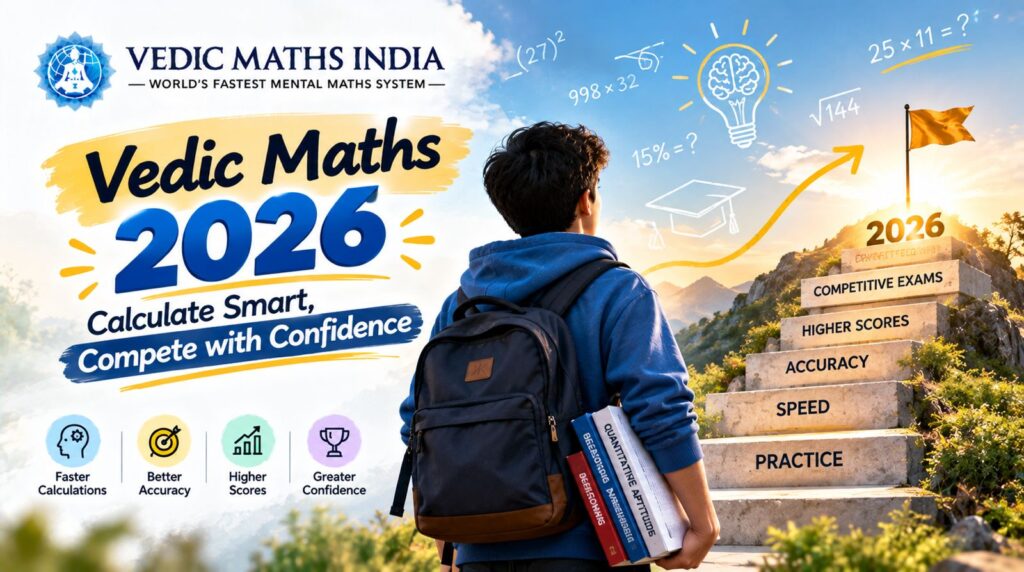
Explore how Vedic Maths can support bank exam preparation and the Vedic Maths Competition 2026 through smarter calculations, timed practice and accuracy.
Why Do Candidates Lose Time on Easy Maths Questions?
A candidate may understand a question perfectly and still spend too long solving it. The reason is not always a lack of mathematical knowledge. Sometimes, the calculation method takes longer than necessary. Under exam pressure, even familiar arithmetic can become a source of hesitation. This is where Vedic Maths can offer another way to approach numerical problems.
Instead of following the same written procedure every time, learners explore alternative calculation methods and number patterns. Depending on the question, these approaches may reduce unnecessary steps and help candidates work more efficiently. For competitive-exam aspirants, the real challenge is to combine speed with accuracy—not to solve every question as quickly as possible.
What Is Vedic Maths, and How Can It Help in Competitive Exams?
Vedic mathematics is a system of mathematical techniques commonly taught for mental calculation, numerical relationships and alternative approaches to arithmetic. Learners practise selecting methods that suit different types of calculations. In competitive examinations, this skill can be useful when working with percentages, averages, ratios, simplification, multiplication and other quantitative problems.
However, not every question becomes easier through a Vedic method. Candidates should compare approaches and use the one that delivers a reliable answer with an appropriate amount of effort. That flexibility is particularly useful when the exam clock is running.
Vedic Maths for Bank Exams: Where Should You Begin?
Bank examinations require preparation across the relevant syllabus, not just faster arithmetic. Vedic Maths for bank exams can support the calculation-heavy parts of quantitative aptitude, including selected simplification, percentage, average, profit-and-loss and data-interpretation questions.
A practical starting plan is to:
- Identify the quantitative topics that take you the longest.
- Strengthen the underlying arithmetic before learning additional techniques.
- Practise alternative methods on suitable questions.
- Compare your time and accuracy with your usual approach.
- Use timed mock tests to determine whether the improvement holds under pressure.
For example, a learner who regularly makes errors in percentage calculations should first understand the relationship between percentages and fractions. Faster techniques become more useful when the underlying concept is clear.
Is Vedic Maths enough to clear a bank exam? No. Candidates must also prepare the full syllabus, practise mock tests and develop a suitable examination strategy. Vedic Maths is a supporting skill, not a replacement for comprehensive preparation.
Vedic Maths Competition 2026: Beyond Fast Answers
A timed mathematics competition tests more than calculation speed. Participants must read questions carefully, choose an approach, maintain concentration and avoid preventable mistakes. Someone who rushes through every problem may finish early but lose marks through errors. The Vedic Maths Competition 2026 can be approached as an opportunity to practise these connected skills, subject to the event’s actual format and rules.
Students preparing for a competition can use a simple review method after every practice session:
- Which questions took the most time?
- Which mistakes occurred more than once?
- Was the chosen technique appropriate?
- Did accuracy decline when the timer was introduced?
- Which area deserves attention in the next session?
This review turns a score into useful feedback. It also helps students set a more specific target for their next attempt.
Before registering, check the organiser’s official announcement for confirmed dates, eligibility, format and participation requirements.
How to Practice for Speed Without Sacrificing Accuracy?
Speed develops through deliberate practice rather than rushing. Start with untimed questions to establish accuracy. Once the method becomes familiar, introduce short timed exercises. Record both the number of correct answers and the time taken.
If your speed improves while accuracy drops, reduce the pressure and revisit the method. When both measures improve consistently, increase the difficulty gradually. This approach can work for school students, competition participants and banking aspirants alike. A useful practice record might include the topic, questions attempted, correct answers, time taken and the main type of error. Reviewing this information over several sessions makes progress easier to evaluate.
How Vedic Maths Forum India Supports Learning?
Vedic Maths Forum India, founded by Gaurav Tekriwal, provides Vedic Mathematics learning programmes for students, teachers and competitive-exam aspirants. Its competitive-exam offering includes quantitative aptitude preparation relevant to banking examinations.
Learners can review the programme details to understand the syllabus, teaching format and available study support before deciding whether it matches their preparation needs.
Visit the official page: Vedic Maths for Competitive Exams. For broader information about the organisation and its educational work, visit Vedic Maths Forum India.
Does AI Change the Way Students Should Practise Vedic Maths?
AI tools can generate practice questions, explain calculations and help learners explore different solution methods. Used carefully, they can make it easier to obtain additional exercises and review mistakes. However, reading an AI-generated solution is not the same as solving the problem independently.
Students should attempt questions first, verify answers and make sure they understand why a method works. This is particularly important for exam preparation, where candidates must perform without depending on an assistant. AI can support the practice process, but independent calculation remains an essential skill.
The Goal Is Better Decisions, Not Just Faster Calculations
A strong candidate knows when to use mental calculation, when to write out a solution and when to move on from a time-consuming question. That judgement develops through concept clarity, varied practice and honest review of mistakes.
Whether your target is the Vedic Maths Competition 2026 or a banking examination, use Vedic Maths to strengthen suitable calculation skills while continuing to prepare for the full assessment. The aim is simple: spend less effort on avoidable calculation steps and more attention on solving the right questions accurately.
Explore Vedic Maths learning and competitive-exam programmes at vedicmathsindia.org.